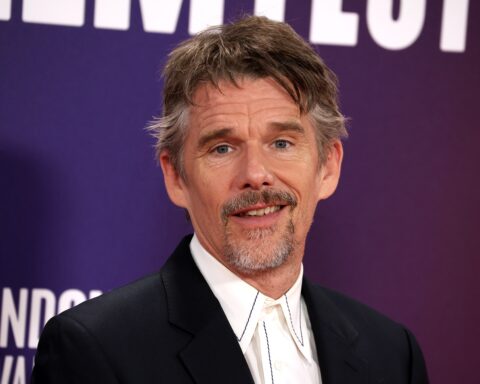

Ethan Hawke has been making movies since 1985. He has been nominated for four Academy Awards.
He has worked with Richard Linklater for 30 years across nine films, two of which earned him Oscar nominations for Best Adapted Screenplay.
He has been called one of the most committed actors of his generation by critics for the better part of three decades.
Until the 98th Academy Awards on March 15, 2026, he had never once been nominated for Best Actor in a Leading Role.
That changed with Blue Moon, Richard Linklater’s intimate period drama in which Hawke plays Lorenz Hart, one of the most celebrated lyricists in Broadway history, on what turned out to be one of the worst nights of his life.
Hawke lost the award to Michael B. Jordan, who won Best Actor for Sinners. The nomination itself, his fifth overall and his first in the lead acting category after four decades in Hollywood, is the thing that matters here, and the story of how it happened is the thing worth telling.
Who Was Lorenz Hart?
Lorenz Hart was born May 2, 1895, in New York City, the son of German Jewish immigrants. He attended Columbia University alongside future collaborator Richard Rodgers, and together they formed one of the most celebrated songwriting partnerships in American musical history.
Rodgers and Hart wrote more than 500 songs across 28 Broadway musicals and numerous films between 1919 and 1943, including “My Funny Valentine,” “The Lady Is a Tramp,” “Bewitched, Bothered and Bewildered,” “Blue Moon,” “Manhattan,” and “Where or When.”
They were defining figures of the Golden Age of American popular music.
Hart was also, by many accounts, one of the most brilliant lyricists who ever lived and one of the most self-destructive.
He was short, approximately five feet tall, deeply insecure about his appearance, privately identified as bisexual at a time when the word did not yet exist in common usage, and struggled with severe alcoholism that grew progressively worse as his partnership with Rodgers began to deteriorate under the strain of his unreliability.
When Rodgers asked him to collaborate on an adaptation of the play Green Grow the Lilacs in 1942, Hart declined, reportedly disappearing on a bender rather than showing up to write.
Rodgers found a new collaborator named Oscar Hammerstein II. The result was Oklahoma!, which opened on Broadway on March 31, 1943, and changed American musical theater permanently.
Lorenz Hart died November 22, 1943. He was 48 years old. The cause was pneumonia, complications almost certainly accelerated by his alcoholism and the collapse of his career.
He had attended the opening of a revival of one of his old shows, Connecticut Yankee, stood outside in the rain, and was found unconscious days later.
What Is Blue Moon?
Blue Moon is set entirely on the night of March 31, 1943, the same night Oklahoma! opened on Broadway.
Linklater and screenwriter Robert Kaplow, working from letters that Hart wrote to a young woman named Elizabeth Weiland, imagined Hart slipping away from the party at Sardi’s restaurant and holding court at the bar as the rest of the theater world celebrated his former partner’s triumph.
The entire film takes place essentially in a single location over the course of a single night. It is, as multiple reviewers have noted, something that could play on a stage with almost no changes.
Hart is played by Hawke as a man hanging on by a thread in every direction simultaneously, professionally, personally, emotionally, physically.
The film follows his conversations over the course of the evening with the bartender Eddie, a piano player named Morty who is an enlisted soldier on leave, Richard Rodgers himself played by Andrew Scott, and Elizabeth Weiland played by Margaret Qualley, the Yale art student with whom Hart has developed an intense attachment through months of correspondence.
Bobby Cannavale also appears. Hart at one point describes himself to Elizabeth as “omnisexual,” which Kaplow’s screenplay treats matter-of-factly and without drama in a period-appropriate manner, reflecting how the Broadway world of the early 1940s already understood Hart’s sexuality.
Hawke shaved his head entirely for the role so that Hart’s distinctive comb-over could be placed on top, and the production used what he described as “old stagecraft” to diminish his height, Hawke stands nearly a foot taller than Hart was.
When Linklater asked for more lines in Hawke’s face for the role, Hawke suggested they fake it. Linklater refused. “No, we won’t fake anything,” he told Hawke.
What Do Reviews Say?
Blue Moon premiered at the 75th Berlin International Film Festival on February 18, 2025, where Andrew Scott won the Silver Bear for Best Supporting Performance.
The film was released theatrically in the United States by Sony Pictures Classics on October 17, 2025, and arrived on Netflix on February 14, 2026. It holds a 90 percent score on Rotten Tomatoes.
The Rotten Tomatoes critics consensus reads: “While not the flashiest Richard Linklater film, Blue Moon boasts a wonderful performance by Ethan Hawke as he embodies a man hanging on by a thread while the audience hangs on to every word said.”
Peter Bradshaw of The Guardian gave the film four stars and specifically praised Hawke’s “terrific performance.”
The Hollywood Reporter called the film “beautifully executed” and praised both lead actors for their ability to mesmerize.
Next Best Picture described it as “witty and fast-paced.” The Irish Times called it “arguably a career-high performance from Ethan Hawke.”
One reviewer on Rotten Tomatoes wrote, “Hawke inhabits this tortured soul who is both an inspired virtuoso and a vulnerable, lonely individual who believes he is unlovable.”
Not all reviews were uniformly positive. The Irish Times also noted that Linklater’s effort to disguise Hawke’s height was “an aesthetic gamble so distracting, so patently absurd, that it nearly sinks the enterprise.”
Some viewers found the relentless negativity of Hart’s character exhausting over the film’s runtime. The film made $554,321 in its first wide release weekend, a modest total reflecting its status as a prestige independent film rather than a commercial release.
The film also received a Best Original Screenplay nomination at the 98th Academy Awards for screenwriter Robert Kaplow.
The Thirty-Year Collaboration
Hawke and Linklater first met when Linklater came to see Hawke perform in a play. That mutual love of theater became the foundation of a partnership that began with Before Sunrise in 1995 and has now produced nine films together.
Before Sunrise was a romantic drama shot in Vienna following two strangers who spend a night together before parting. It launched a trilogy that continued with Before Sunset in 2004, which earned them both a Best Adapted Screenplay Oscar nomination, and Before Midnight in 2013, which earned them another.
Boyhood, released in 2014 and shot in segments over twelve years with the same cast, earned Hawke a Best Supporting Actor nomination and became one of the most celebrated films of the decade.
Blue Moon is the ninth Hawke-Linklater collaboration. A tenth script is currently being completed.
Hawke told The Hollywood Reporter he called it “the greatest film ever made,” adding, “I say that every time I go to work. I’m like one of those athletes who guarantees victory all the time. And you know, sometimes I’m right.”
Linklater told interviewers he had worked on Blue Moon for twelve years before production.
He waited specifically because he felt Hawke was not yet old enough for the role. “Rick was like, ‘I need you to have more lines in your face,'” Hawke recalled.
The film began as something they made purely for its own sake. Hawke told Variety,
“We would’ve done the whole thing for free and been happy if nobody saw it. That’s kind of how all the projects I’ve done with him have felt. When you get to go to a big dance like this, with work you did with one of your best friends in the whole world, you kind of feel like you beat the algorithm.”
Five Nominations, One First
Hawke’s career covers more than forty years and includes Dead Poets Society, Before Sunrise, Training Day, Before Sunset, Before Midnight, Boyhood, Sinister, The Black Phone, and dozens of other films.
His first Oscar nomination came in 2002 for Training Day, where he played a rookie detective opposite Denzel Washington’s Oscar-winning performance as a corrupt cop.
He was 31 years old. “The first time is otherworldly,” he told Vanity Fair of that nomination. “You feel like you’re in The Hunger Games.”
His second and third nominations came in 2004 and 2013 for Best Adapted Screenplay on Before Sunset and Before Midnight respectively, shared with Linklater and Julie Delpy. His fourth came in 2015 for Best Supporting Actor for Boyhood.
None of those four nominations were for Best Actor in a Leading Role. Blue Moon is the first time the Academy has recognized him in that category, and it came at age 55.
He described what he took away from the experience of making the film to Variety in a single phrase: “Rick’s unflagging friendship.”
On the Oscar campaign trail, which he described as the most intensive of his career, Hawke told The Hollywood Reporter he thought about the whole thing not as self-promotion but as advocacy for independent film.
“If you see this whole thing as an advertisement for our industry, then it starts to be fun, like, OK, let’s remind everybody that these movies are important and a relevant part of our culture,” he said. “I’m going as an ambassador for independent film. You’ve got to try to not make it about yourself. Otherwise, it just gets too weird.”
Blue Moon is streaming now on Netflix.