
The watch world went to Geneva on April 14 expecting one of two outcomes.
Either the Rolex GMT-Master II Pepsi would be officially retired and replaced by the long-awaited Coke, or months of escalating speculation would turn out to be noise and the red and blue bezel would survive another year.
Nobody predicted option three. The Pepsi is gone. The Coke never arrived.
For the first time in the ceramic era of the GMT-Master II, Rolex’s steel lineup contains no red bezel at all, and the brand has not offered a single word of explanation.
Watches & Wonders 2026 confirmed what WatchPro had reported in February: Rolex informed authorized dealers there would be no further deliveries of the ref. 126710BLRO in Oystersteel or the ref. 126719BLRO in white gold.
The white gold Submariner Date “Cookie Monster” (ref. 126619LB) went with them.
All three vanished from the official Rolex configurator during the April 14 product refresh, and the 126710BLRO product page now returns a dead end.
What had been on dealer waiting lists for years is now a closed chapter.
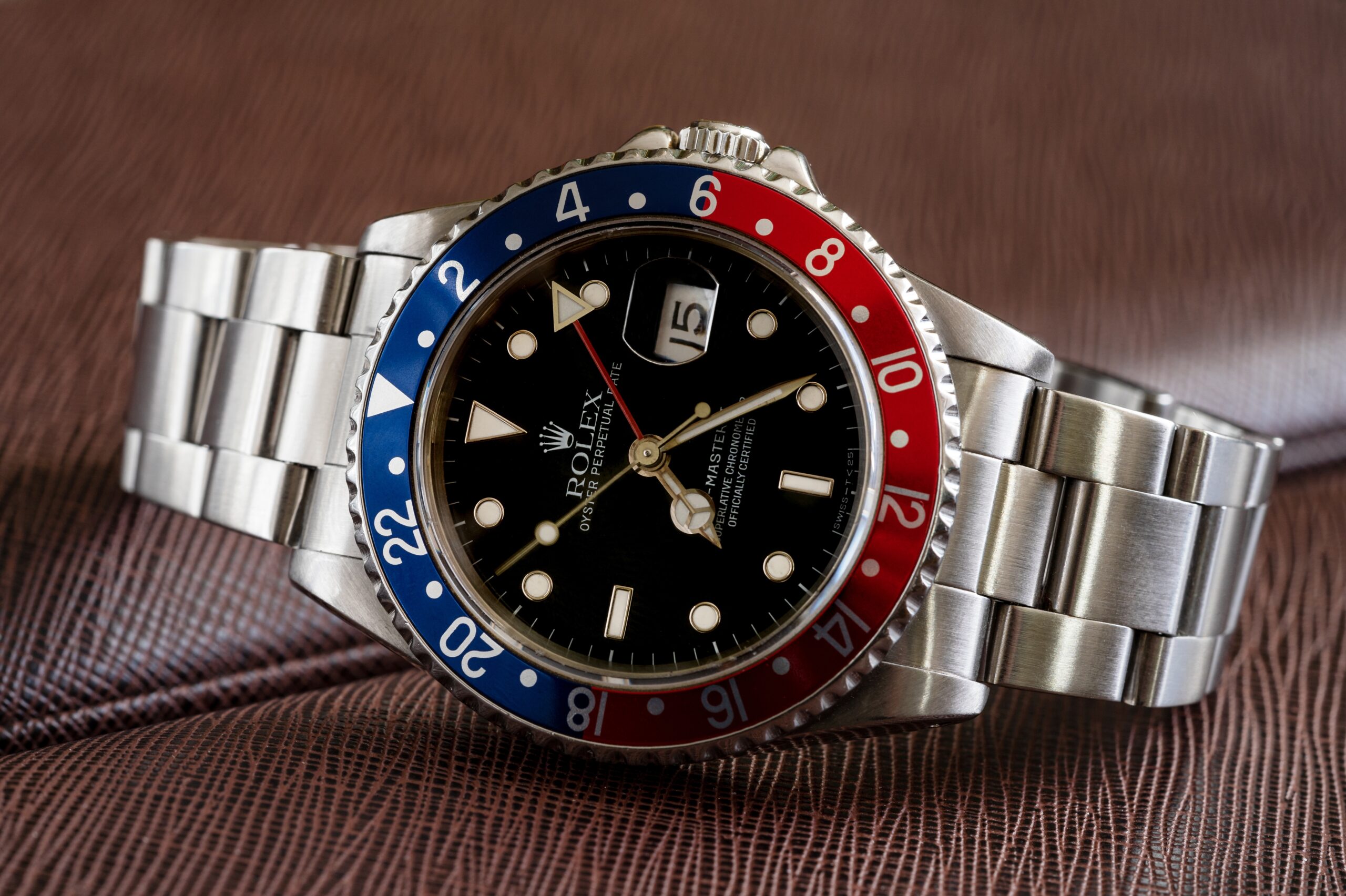
What Was The Pepsi Rolex?
The GMT-Master II “Pepsi” nickname comes from the red and blue Cerachrom ceramic bezel insert that gives the watch its distinctive look, the colors of a particular cola brand that anyone over the age of five can identify on sight.
The name stuck decades ago and never left. The bezel colorway itself traces back to 1955 and the original GMT-Master, a watch built specifically for Pan Am pilots who needed to track two time zones simultaneously while crossing the Atlantic.
The red and blue bezel was how you read which half of the day you were in on each timezone. Red for daytime hours, blue for night.
The modern ceramic iteration of that bezel took until 2014 to arrive, because producing a stable two-color ceramic insert is technically difficult.
Rolex’s own 2013 patent on the manufacturing process acknowledged that “due to the many variables in the pigmentation process, the results may not always be consistent.”
The white gold Pepsi (ref. 116719BLRO) debuted that year as the first ceramic version. Rolex took four more years before putting the same bezel on a steel case.
When the ref. 126710BLRO arrived at Baselworld 2018 on a Jubilee bracelet, it became one of the defining watches of the modern era immediately.
The watch had everything. A 40mm Oystersteel case, the Calibre 3285 movement with a 70-hour power reserve, the iconic bezel in a material that would last indefinitely, and a history stretching back to the jet age.
Paul Altieri, CEO of Bob’s Watches, described it simply: the Pepsi is “in its own category because it has such a special look and it’s been around for 70 years.”
The retail price in the UK was £9,850. The waitlists were years long. Grey market premiums regularly pushed it past two or three times retail during the peak of the 2020-2022 speculation cycle.
Even after that market cooled, the Pepsi remained the most culturally significant steel sports Rolex in active production.
The ref. 126710BLRO ran for eight years. It joins a lineage. The ref. 6542, the ref. 1675, the ref. 16710. The steel ceramic Pepsi will be remembered as the icon of its era.
The Cookie Monster
The white gold Submariner Date with the bright blue ceramic bezel, the “Cookie Monster,” named after the famous blue Muppet, was discontinued alongside the Pepsi references.
The ref. 126619LB was a more niche piece than the steel sports Rolex crowd typically chases. A white gold case paired with Rolex’s boldest Cerachrom coloring, sitting at a significantly higher price point than anything in steel.
It didn’t generate the same cultural noise as the Pepsi, but it had its own following among collectors who wanted a Submariner that made a statement in precious metal rather than understated steel. It is gone now too.
The Coke Rolex That Never Came
The reason Watches & Wonders 2026 was supposed to be straightforward is a patent. In 2022, Rolex filed US patent 12,428,335 B2, which describes a manufacturing process specifically capable of producing a stable red and black ceramic bezel insert.
The “Coke” colorway, named, again, after a particular cola brand, has been part of the GMT-Master’s history since 1982, when it debuted on the ref. 16760 “Fat Lady.”
The last Coke was the ref. 16710, discontinued in 2007. It has never been produced in ceramic. The 2022 patent pointed directly at that gap.
When you have a brand discontinuing its most famous product while simultaneously holding a patent that perfectly describes the replacement, the logical conclusion is obvious.
Every major watch publication reached it. Hodinkee, Bob’s Watches, WatchPro, Fratello, Robb Report, the consensus was that a ceramic Coke GMT was coming at Watches & Wonders 2026, almost certainly in white gold first, following the same pattern the Pepsi took when it debuted in white gold in 2014 before arriving in steel four years later.
Rolex introduced no Coke. The entire prediction infrastructure of the watch world, built over months of dealer intelligence, secondary market tracking, patent analysis, and source-confirmed reporting, produced the wrong answer.
The Pepsi is gone, the slot it occupied in the lineup is empty, and Rolex has chosen silence.
Two explanations circulate. The first is technical: achieving a stable red and black ceramic transition may still carry some of the same “bleeding” issues that plagued early red and blue production, and the patent describes the process without guaranteeing it has been perfected.
The second is strategic. By not delivering the Coke alongside the Pepsi’s exit, Rolex preserves a guaranteed hype event for a future show when the calendar might otherwise be quiet.
The unpredictability is the point. Bob’s Watches editorial framed it directly: “The moment a brand becomes entirely predictable, the mystique that drives demand begins to erode.” Rolex proved every publication wrong simultaneously, then said nothing about it.
The Current GMT-Master II Lineup
After the removals, the steel GMT-Master II catalog stands at four references. The “Batman,” black and blue bezel on an Oyster bracelet.
The “Batgirl,” black and blue on a Jubilee. The “Bruce Wayne,” grey and black.
The “Sprite,” green and black on a left-hand crown configuration.
Not one of them has a red bezel. For anyone who wanted a modern steel GMT with red in the design, the catalog no longer accommodates that.
The Secondary Market In Real Time
The market had been pricing in the discontinuation since February, when WatchPro confirmed dealers were told no further deliveries were coming. By early March, Chrono24 reported a 500 percent surge in purchase requests for the 126710BLRO in a single week.
Bloomberg’s Subdial Watch Index tracked a roughly US$3,000 jump in median prices from the start of the year.
Australian dollar median prices climbed from around $31,000 to over $35,600 in six months.
Active listings dropped by a quarter. Unworn examples appeared at $45,000 asking price, with many others listed above $30,000.
When the Coke failed to arrive at Watches & Wonders and the Pepsi’s discontinuation was confirmed without replacement, those price dynamics shifted again.
The 126710BLRO is now the only modern steel option for a collector who wants a red bezel on a GMT-Master II. That slot does not exist in the current catalog. There is no new supply coming.
The parallel most commonly cited is the Submariner “Hulk,” the green-dialed ref. 116610LV discontinued in 2020. Values climbed steadily after collectors realized the waitlist was closed.
The watch entered a different tier of collectability. The key difference was that the Hulk was eventually replaced by the “Kermit” with a green ceramic bezel. As of Watches & Wonders 2026, the Pepsi has no announced replacement.
Expert opinion on where prices go from here is divided. Joshua Ganjei, CEO of European Watch Company, said the Pepsi “blends heritage and everyday wearability in a way few watches do” and expects immediate upward pressure.
Tim Bender, founder of the pre-owned platform Collected, is more skeptical:
“This isn’t the market of three to four years ago. Many speculative buyers were burned during the peak frenzy and never returned. Speculative demand is a shadow of its former self. I’d expect prices to settle back into the low $20s once the dust clears.”
The truth will play out over months, not hours.
What Rolex Was Actually Announcing
While the GMT story dominated the conversation, the 2026 Rolex collection had a distinct theme. 100 years of the Oyster case.
The headline piece was an Oyster Perpetual 41 in yellow Rolesor with a slate dial, green anniversary details, and a “100 years” inscription at six o’clock, historically significant, deliberately understated, which is entirely on brand.
The Datejust 41 received a shadow dial update. The Yacht-Master II returned after being discontinued in 2024, with new materials engineering behind it.
The Daytona appeared in an “exceptional watches” category under a new alloy, pointing toward something new in Rolex’s materials direction.
None of that is irrelevant to the GMT story. Rolex’s 2026 collection was focused on celebrating its own history, not on filling a gap it created by removing one of the most wanted watches in the world.
Whether the ceramic Coke arrives at Watches & Wonders 2027, or 2028, or somewhere further out, is now the question that replaces the one that seemed settled this week.
The blue and red bezel has been part of the GMT-Master story since the beginning. It left the catalog for 11 years between 2007 and 2018 and came back as the most desirable watch Rolex made.
What happens to it now is, as always, entirely up to Rolex, which will not tell you, and does not have to.