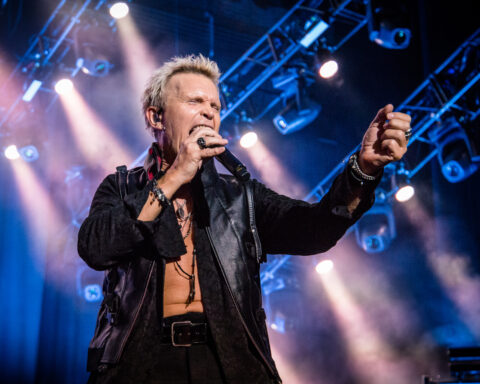

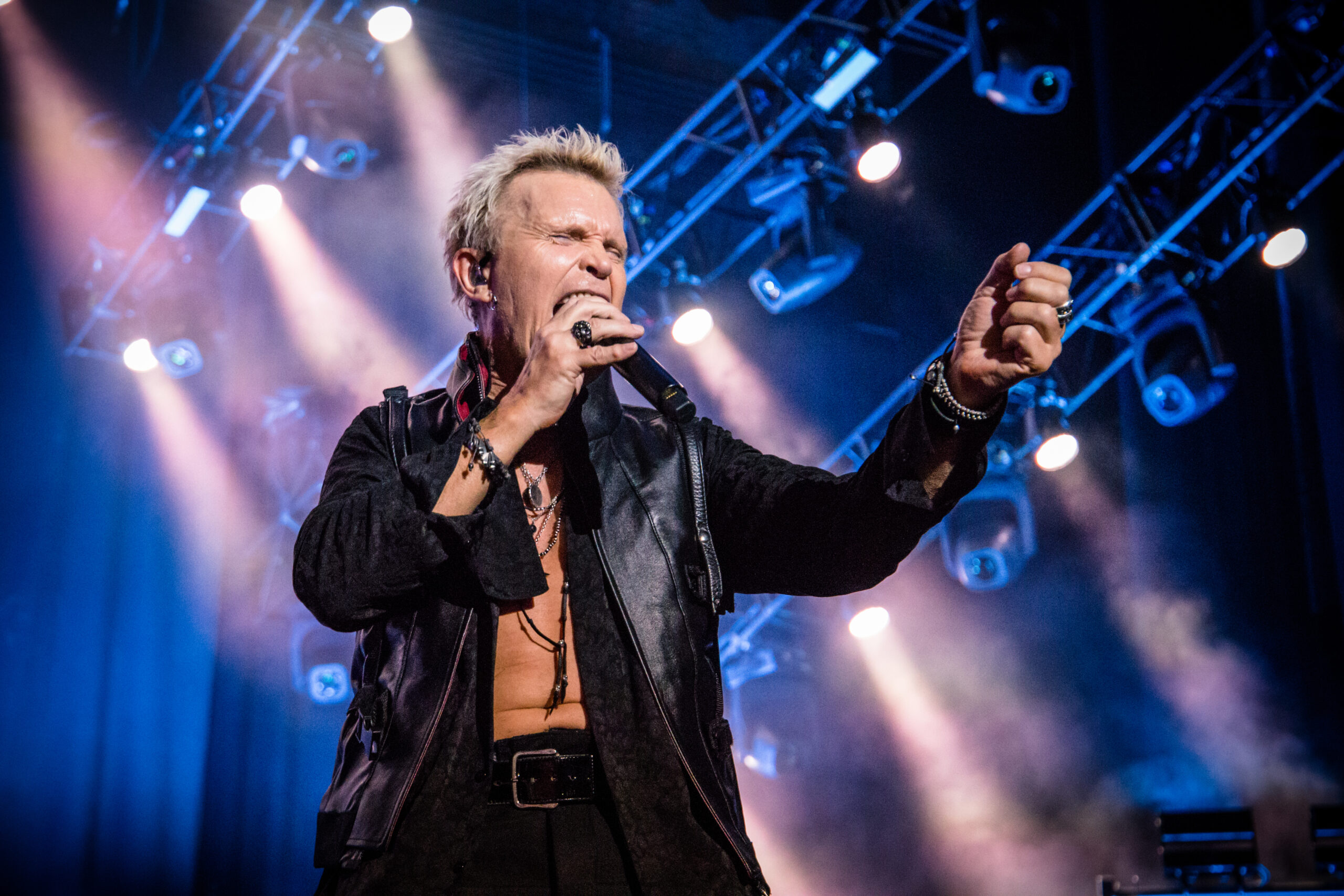
Billy Idol is 70 years old, is currently nominated for the Rock and Roll Hall of Fame, and on Thursday, March 26, a feature-length documentary about his life arrives on Hulu.
The film comes with a title that says everything about the story it tells, Billy Idol Should Be Dead. In two days, a lot of people are going to discover just how accurate that title is.
The film is directed by Jonas Åkerlund, the Swedish filmmaker who has spent three decades directing some of the most visually inventive music videos in the industry, working with Madonna, U2, Lady Gaga, and Beyoncé, among others, and winning three Grammy Awards along the way.
Åkerlund brings that same instinct for image and rhythm to a documentary that Idol himself has described as “warts and all,” a phrase he used deliberately, because he did not want this to be, as he put it, “just a glorified Behind the Music.”
The title refers to two specific moments. In 1984, at the height of his fame, Idol nearly died from a heroin overdose.
In 1990, he was involved in a motorcycle crash so severe he nearly lost a leg. He survived both. He has said simply, “I should be dead, but someone up there likes me.”
What Did Miley Cyrus Say About Billy Idol?
The documentary’s trailer opened with a moment that immediately went everywhere online.
Archival footage shows a young Idol being interviewed by a journalist who asks him what he’d do if he became a rock star and had money. Without blinking, Idol replies, “I’d spend it on drugs.”
From there the trailer spans his career, and then Miley Cyrus appears on screen. Cyrus, who collaborated with Idol on the 2020 song “Night Crawling” and performed with him before Super Bowl LV in Tampa in February 2021, does not hold back in her assessment of the man.
“I watch Billy Idol footage like it’s porn,” she says. “There’s no one hotter than Billy-f******-Idol.”
Who Else Is In The Documentary?
The film features a remarkable range of voices from across five decades of rock history.
Billie Joe Armstrong of Green Day and Duff McKagan of Guns N’ Roses appear, as do Pete Townshend of the Who, John Taylor of Duran Duran, and Steve Jones and Paul Cook of the Sex Pistols, the band that sent a teenage Idol running back to London from college the moment he heard they existed.
Steve Stevens, Idol’s longtime guitarist and collaborator, features prominently, as do Tony James and Derwood Andrews, his bandmates in Generation X, the British punk band that was his first real vehicle before he went solo.
Also interviewed are Brendan Bourke of Chrysalis Records, and Idol’s younger sister Jane Broad.
His mother, Joan Broad, was still alive to be interviewed for the film but died in 2020 before it was completed. Her presence in it is, by all accounts, one of its most moving elements.
The documentary uses anime animation for parts of the story where no footage exists, a technique that allows the film to illustrate the earliest and most chaotic chapters of Idol’s life without gaps.
Who Is Billy Idol?
Billy Idol, born in England in 1955, raised in Bromley about an hour outside London, was a teenager who started going into the city to see live music in the early 1970s.
He was part of what became known as the “Bromley Contingent,” the tight group of young people who got into London’s punk scene at the very beginning, when, as Idol puts it in the film, the entire scene amounted to roughly 200 people.
He placed an ad in Melody Maker looking for a bass player. Tony James answered. They co-founded Generation X, whose “Dancing with Myself” became one of punk’s more enduring anthems.
Idol relocated to New York in 1981 and went solo. What followed was one of the defining careers of the MTV era, “White Wedding,” “Rebel Yell,” “Eyes Without a Face,” “Mony Mony,” “Cradle of Love,” a run of hits built on a combination of punk aggression and pop accessibility that made him one of the most recognisable faces of the 1980s.
The bleached hair, the sneer, the leather and chains: it was an image that lodged permanently in the cultural memory of an entire generation.
Then came the overdose. Then the motorcycle crash. Then the years of trying to find his way back.
“It’s easy to say it’s the drugs,” Idol says in the film. “But what about if it’s me? What about if it’s me doing this?” That question, honest and uncomfortable and not entirely answerable, sits at the centre of everything the documentary is trying to do.
He has three grown children from three different relationships and three granddaughters.
His mother was interviewed for the film and did not spare him. He has said she saw through the myth entirely, and her presence in the documentary is part of what makes it something other than a straightforward celebration.
When Does The Documentary Debut?
Billy Idol Should Be Dead premiered at the Tribeca Film Festival on June 10, 2025, and received a limited theatrical run beginning February 26, 2026.
It arrives on Hulu this Thursday with an original song attached: “Dying to Live,” written by Idol alongside Academy Award-nominated songwriter J. Ralph and longtime collaborators Steve Stevens, Tommy English, and Joe Janiak.
The song was shortlisted for Best Original Song at the 98th Academy Awards and plays through the film’s closing sequence.
Simultaneously, Idol sits among the 2026 Rock and Roll Hall of Fame nominees, his second nomination, alongside Iron Maiden, Phil Collins, Oasis, Lauryn Hill, Mariah Carey, Joy Division/New Order, Wu-Tang Clan, and Shakira, among others. Fan voting is currently open.
It is, as Idol himself has acknowledged, a strange and unexpected place to find yourself at 70, more visible, more discussed, more celebrated than you’ve been in decades.
The documentary is probably the reason for all of it.