Costco Stock Is Down 4 Percent After Beating Earnings And Here’s What We Know
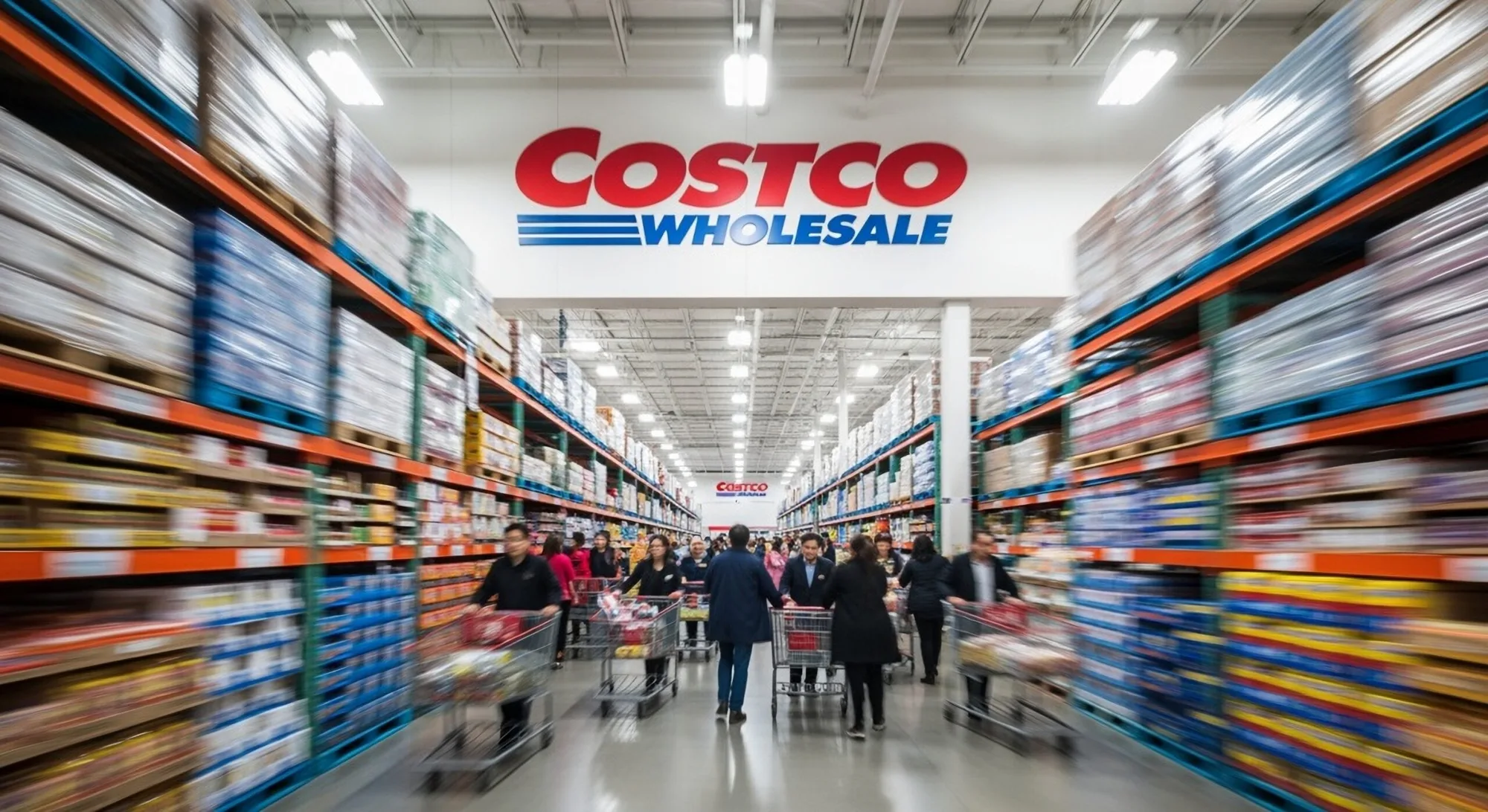
Costco Wholesale Corporation reported fiscal third quarter 2026 results on Thursday evening that, by almost any conventional measure, were strong. Total revenue of $70.53 billion beat analyst consensus.
Net income grew 15 percent year over year. The company set an all-time record for gasoline sales volume, a direct result of the Iran War driving fuel prices higher and sending consumers flooding to Costco’s fuel stations in search of the cheapest gas in their zip code.
CEO Ron Vachris told analysts that the quarter’s closing stretch produced the best sales weeks in the company’s history.
Costco stock is down approximately 4 percent on Friday.
The result is the specific kind of market event that confuses people who are new to following high-valuation stocks and that is immediately recognizable to people who are not.
Costco entered this earnings report trading at approximately 52 times forward earnings. At that valuation, the company does not get credit for strong results.
It gets punished for results that are strong but not stronger than the market’s elevated expectations. At more than 50x earnings, COST needed more than solid results.
What it delivered was a small EPS miss against some estimates, slight gross margin compression, comparable store sales that looked better than they were because of gasoline price inflation and a membership renewal rate that dipped below 90 percent for the first time, a metric that justifies a significant portion of Costco’s premium valuation and that investors watch with the vigilance of a cardiologist monitoring a patient with a history of heart disease.
A small EPS miss, reported margin pressure, and gasoline-driven sales mix were enough to keep the stock under pressure.
The Record Gas Volume And What It Actually Means
The headline from the WAVY News report and Costco’s own earnings call is the record gasoline sales volume, a legitimately remarkable operational achievement that reflects a genuine consumer behavior shift driven by the Iran War’s impact on fuel prices.
Vachris said on the call that escalating fuel costs tied to the Middle East conflict had drawn shoppers to Costco’s pumps who had never used them before.
When gas prices rise sharply, as they have since Operation Epic Fury began on February 28, price-conscious consumers who might not have considered a Costco membership specifically for fuel access start calculating whether the membership fee pays for itself in gas savings alone.
At current fuel prices, for many households the math works clearly in Costco’s favor. New customers who arrived at the fuel stations in Q3 are now potential warehouse shoppers.
Vachris acknowledged the downstream opportunity this creates. He noted that gas-station users historically generate higher warehouse spending than non-gas-station users, that the same households who trust Costco to save them money on fuel tend to extend that trust to groceries, electronics, pharmaceuticals and the bulk purchases that define the warehouse club value proposition.
Vachris noted that gas-station users historically generate higher warehouse spending, making the fuel traffic a potential long-term revenue driver.
The qualification embedded in “potential” is doing significant work there. The record gas volume is real and impressive. It is also, at its core, a consequence of a war in the Middle East that will end at some point.
When the Iran War resolves and fuel prices normalize, as they have partially begun to do on days when peace negotiation progress is reported, the specific tailwind that brought new customers to Costco fuel stations in Q3 will diminish.
Gasoline-driven sales mix is not a durable revenue driver. It is a windfall that the company is wisely leveraging while it lasts, but the 9.8 percent headline comparable sales figure masks the fact that the underlying organic growth, comparable sales excluding gas prices and foreign exchange, was 6.6 percent. Strong, but not the number the headline suggests.
The Margin Compression That Concerns Investors
The gross margin story in Q3 is a two-part narrative that reflects both intentional strategic choices and unavoidable cost pressures.
On the intentional side, Costco’s management made the decision to absorb higher costs on specific everyday items, eggs and beef were cited on the earnings call, rather than passing those increases to members. This decrease was due to slightly lower margins in fresh and food and sundries, where we invested in lower prices for our members on several everyday items such as eggs and beef.
Costco’s entire value proposition to its membership is built on the guarantee that it will find ways to offer better prices than alternatives, even when input costs are rising.
The CEO articulated that philosophy directly on Thursday’s call: “Our goal is to be the first to lower prices and the last to raise them.”
That commitment to pricing discipline is a long-term strength and a short-term drag on margins.
At 52 times earnings, short-term margin compression has an outsize impact on investor confidence precisely because the valuation already prices in long-term margin stability.
The CFO introduced a forward-looking concern that amplified the margin worry.
Transportation costs were a headwind in Q3, and the CFO flagged further anticipated rises in non-food categories due to resin-related input costs, the raw material that goes into plastics, packaging and a wide range of consumer goods.
Resin prices have been elevated by the same energy price pressures that are driving gasoline costs.
As those costs work their way through the supply chain, Costco will face the choice between absorbing them and passing them to members, the same choice it made on eggs and beef, repeated across a broader category range.
The Membership Number That Every Investor Is Watching
Costco’s membership model is the specific structural feature that justifies its premium valuation relative to other retailers. Membership fee income provides a recurring, predictable, high-margin revenue stream that is almost entirely independent of merchandise margins.
When Costco’s gross margins compress because it is subsidizing member prices, the membership fee income provides a stable foundation underneath the variability.
Membership fee income rose by 10.7%, driven by growth in Executive memberships.
The metric that matters most for the long-term durability of that foundation is the renewal rate, the percentage of members who choose to pay for another year when their membership expires.
Costco’s renewal rate has historically been one of the most impressive statistics in all of retail, running consistently at or above 90 percent in the United States, reflecting the specific kind of consumer loyalty that is extraordinarily difficult to replicate and that prevents almost all competitive pressure from making a dent in the membership base.
In Q3, the renewal rate dipped below 90 percent. The specific number was not disclosed, it was described as slightly below the threshold. The dip is small enough that it may represent normal statistical variation rather than a trend.
It may also represent early evidence that the membership fee increases Costco implemented last year are working their way through the renewal cycle and creating a modestly higher hurdle for some members.
Concerns remain regarding a slowdown in membership growth and a dip in renewal rates below 90%, impacting Costco’s premium valuation supported by membership stability.
For a stock trading at 52 times earnings, a dip below a critical metric threshold, even a small one, is sufficient to trigger the kind of valuation discipline that produces a 4 percent down day on an otherwise strong earnings report.
What The Results Actually Say About The Business
Stripping away the valuation dynamics, what the Q3 FY2026 results actually say about Costco’s business is positive. Revenue grew 11.6 percent. Net income grew 15 percent.
Membership fee income grew 10.7 percent. Digital sales accelerated meaningfully. International comparable sales were strong.
The company is actively seeking refunds on tariffs struck down by the Supreme Court and has committed to passing those savings to members, a positioning decision that reinforces the value proposition that drives membership loyalty.
Top-selling categories during the quarter included pharmacy, home furnishings, and gold and jewelry.
Q3 did not weaken the long-term case. It did not meaningfully advance it either. Revenue growth was robust, membership income expanded and digital sales accelerated.
But for a company priced at 52 times earnings, the combination of a narrow EPS miss, gross margin pressure, fuel-inflated comps and a membership renewal rate below 90 percent was enough to trigger the 4 percent decline that Friday’s trading session is delivering.
The business is fine. The stock is expensive. The two things produced today’s result.