
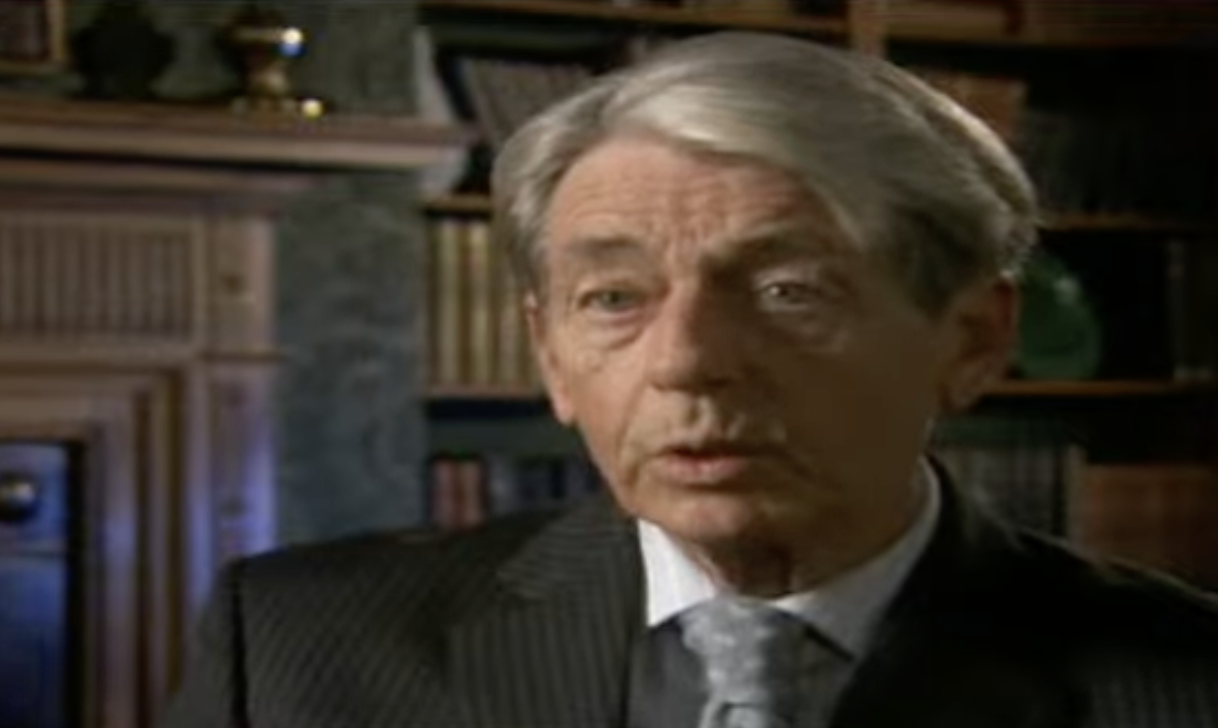
Dark Knight Rises actor John Nolan, the paternal uncle of Christopher and Jonathan Nolan who appeared in four of his nephew’s films and became one of television’s most quietly menacing villains on Person of Interest, died on April 11, 2026.
He was 87 years old. His death was reported by the Stratford-upon-Avon Herald. No cause of death was shared publicly.
Christopher Nolan issued a statement that said everything about what the man meant to him. “My uncle John was the first artist I knew, and he taught me more than anyone about the search for truth in acting and the joys of creative achievement.”
The first artist he knew. That is not a line written out of obligation.
Who Was John Nolan?
John Francis Nolan was born on May 22, 1938, in London. He was the younger brother of Brendan Nolan, who was the father of Christopher and Jonathan.
Long before his nephews became two of the most prominent names in American film and television, John was building a career the old-fashioned way, on the stages of Britain and Ireland, learning his craft in conditions that demanded everything.
Before he ever attended drama school, Nolan toured Ireland in the 1960s with a “Fit Up” traveling theater company, the bottom rung of professional theater, the kind of work where you played every size of room in every kind of town and learned to hold an audience with nothing but your voice and your stillness.
That foundation never left him. You can hear it in every quiet, dangerous scene he later played on Person of Interest. The calm that reads as threat. The economy that implies enormous depth.
From that traveling circuit he went to the Drama Centre London, then to the Richmond Theatre in 1967, where he was cast as Romeo opposite Francesca Annis as Juliet.
That casting told the room something. He joined the Royal Court Company, then the Royal Shakespeare Company at Stratford, where he played Clitus in Julius Caesar, appeared in The Merry Wives of Windsor, and worked in The Relapse directed by Trevor Nunn at the Aldwych.
Nunn was impressed enough that Nolan eventually joined his innovative National Theatre ensemble company.
He played Oberon in the open air at Regent’s Park. Over the years he worked through the major male Shakespearean canon as naturally as an actor grows into it, Romeo in youth, then Hamlet, Richard II, the older kings and the magical figures. He did not rush any of it.
He also won the Best Actor award at the Dublin Festival for his performance of Thoreau in The Night Thoreau Spent in Jail.
He co-wrote and performed in a Dostoyevsky Trilogy for the Bristol Old Vic. He directed productions in Singapore, Kuala Lumpur, and Penang.
He taught at Stratford College for years, passing the same rigorous approach to performance down to a generation of actors who will carry it further.
His wife Kim Hartman, best known herself as Helga in the BBC comedy ‘Allo ‘Allo!, described him as “a popular and talented teacher, whether explaining a Shakespeare soliloquy or how to swing a golf club.”
He also narrated documentaries, voiced the Discovery Channel’s in-flight entertainment for international airlines, and narrated The Clangers to a live orchestra at the Royal Festival Hall.
This is not the CV of a man who rode his nephews’ coattails. This is the CV of someone who spent sixty years doing the work.
John Nolan’s Television Career: From the BBC to CBS
British audiences knew Nolan from decades of television work long before American audiences ever found him. In 1970 he left the RSC to take the title role in the BBC’s adaptation of George Eliot’s Daniel Deronda, a young man with mysterious origins at the center of the novelist’s final work.
The production gave him his first national profile on British television and led directly to more work.
That same year he was cast as scientist Geoff Hardcastle in the BBC environmental drama Doomwatch, a role he held for two seasons.
He played Nick Faunt in ITV’s Shabby Tiger in 1973, a romantic miniseries set in Depression-era Manchester.
He appeared in The Prisoner, The Sweeney, Return of the Saint, Silent Witness, Hustle, Crown Court.
He played Ian Fleming in The Real James Bond. He took the title roles in television productions of Hamlet, Richard II, and The Importance of Being Earnest for RTE in Ireland.
Over fifty television credits by the time his American career began in earnest.
When Jonathan Nolan created Person of Interest for CBS, a show about an AI that monitors all human communication to identify threats, which ran from 2011 to 2016, he brought his uncle in during the second season in 2013.
What was designed as a memorable guest turn became something considerably larger. John Nolan played John Greer, a former MI6 operative now running Decima Technologies, a shadowy private intelligence firm, and the human agent behind a rival AI called Samaritan.
He appeared in 28 episodes across four seasons, remaining with the show through its fifth and final season in 2016.
Jonathan Nolan explained his casting logic with characteristic directness:
“The best bad guys are always English. That’s just kind of a rule. And so my uncle came on board in exactly the same fashion as all of these actors, as a memorable turn that became a longer story arc.”
What Nolan did with Greer was something that only a classically trained actor with decades of experience could do. Greer was a villain who believed completely in what he was doing.
His threat came not from rage or vanity or cruelty but from ideological certainty, the terrifying calm of a man who has decided that the ends justify everything and has no remaining doubt about it.
Nolan played him with a stillness that made every scene he inhabited slightly dangerous. No scenery-chewing. No announcing himself. Just the quiet authority of someone who has spent his whole life learning how to hold a room without raising his voice.
He was in his mid-seventies when he joined the show. He brought nearly half a century of craft to a role that needed exactly that.
The show evolved into one of the more prescient examinations of surveillance, artificial intelligence, and the ethics of watching, subjects that have only grown more urgent in the decade since it ended.
Greer, as the human face of Samaritan’s cold logic, was its most compelling embodiment of what an unchecked surveillance state actually serves.
The Nolan Films
Christopher Nolan’s debut feature, Following, was shot in 1998 in black and white for approximately £6,000.
John Nolan appeared in it as a policeman. That a director who would go on to win the Academy Award for Best Director for Oppenheimer made his first film with his uncle in the cast is not a footnote.
It is the beginning of a creative relationship that ran for nearly three decades.
In 2005, Christopher made Batman Begins, the film that reset what a superhero movie could be and launched one of the most successful film franchises in history.
John played Douglas Fredericks, a member of the Wayne Enterprises board. Christian Bale was Bruce Wayne. Michael Caine, Gary Oldman, Morgan Freeman, Liam Neeson, Cillian Murphy were in the cast.
John Nolan was in it too, quietly doing exactly what the scene required.
He reprised Douglas Fredericks in The Dark Knight Rises in 2012, the concluding chapter of the trilogy, co-written by Christopher and Jonathan, which brought in Tom Hardy as Bane and Anne Hathaway as Selina Kyle alongside Bale’s final appearance as Batman.
It is one of the highest-grossing films in cinema history. Nolan appeared in it because Christopher kept casting him, and because every actor in every Christopher Nolan film earns their place.
In 2017 he was the Blind Man in Dunkirk, Christopher’s WWII film that depicted the evacuation of Allied soldiers from the beaches of northern France.
The film was nominated for eight Academy Awards and won three. Nolan was 78 when it was released.
His final screen credit was the Speaker of the High Council in Dune: Prophecy, the HBO series set in the Dune universe centuries before Denis Villeneuve’s films. He filmed it at 85.
A career that began on Irish roads in a traveling theater company ended in a science fiction prequel set on an interstellar empire. Something about that trajectory feels exactly right.
The Man Behind The Roles
Kim Hartman’s statement to the Stratford-upon-Avon Herald was that of someone describing a person she had known intimately for fifty years, they married in 1975.
She called him “a free spirit, who always knew what he wanted and acted on his own terms. the only truly original thinker I think I ever knew. Articulate, intelligent and with an anarchic wit, he was always willing to see both sides of an argument. He was also the kindest person I ever knew — and animals loved him too.”
The family has asked for privacy. John Nolan is survived by Kim, their children Tom and Miranda, and their grandchildren Dylan and Kara.
Christopher Nolan’s statement does not perform grief. It locates something true. An uncle who was the first artist he knew.
Who taught him more than anyone about the search for truth in acting. Who showed a boy what creative achievement looked like before the boy had any idea what he would go on to do.
The films those lessons eventually contributed to, The Dark Knight, Inception, Interstellar, Oppenheimer, have been seen by hundreds of millions of people.
The teacher did not need to be in every frame to be present in all of it.
John Nolan was 87. He worked until he was 85. He spent his entire adult life on stages, in television studios, and on film sets, doing the work with the same honesty and craft he apparently brought to everything else.
The kind of actor audiences trusted without always knowing why. The stillness. The authority. The quiet that made you lean in.