
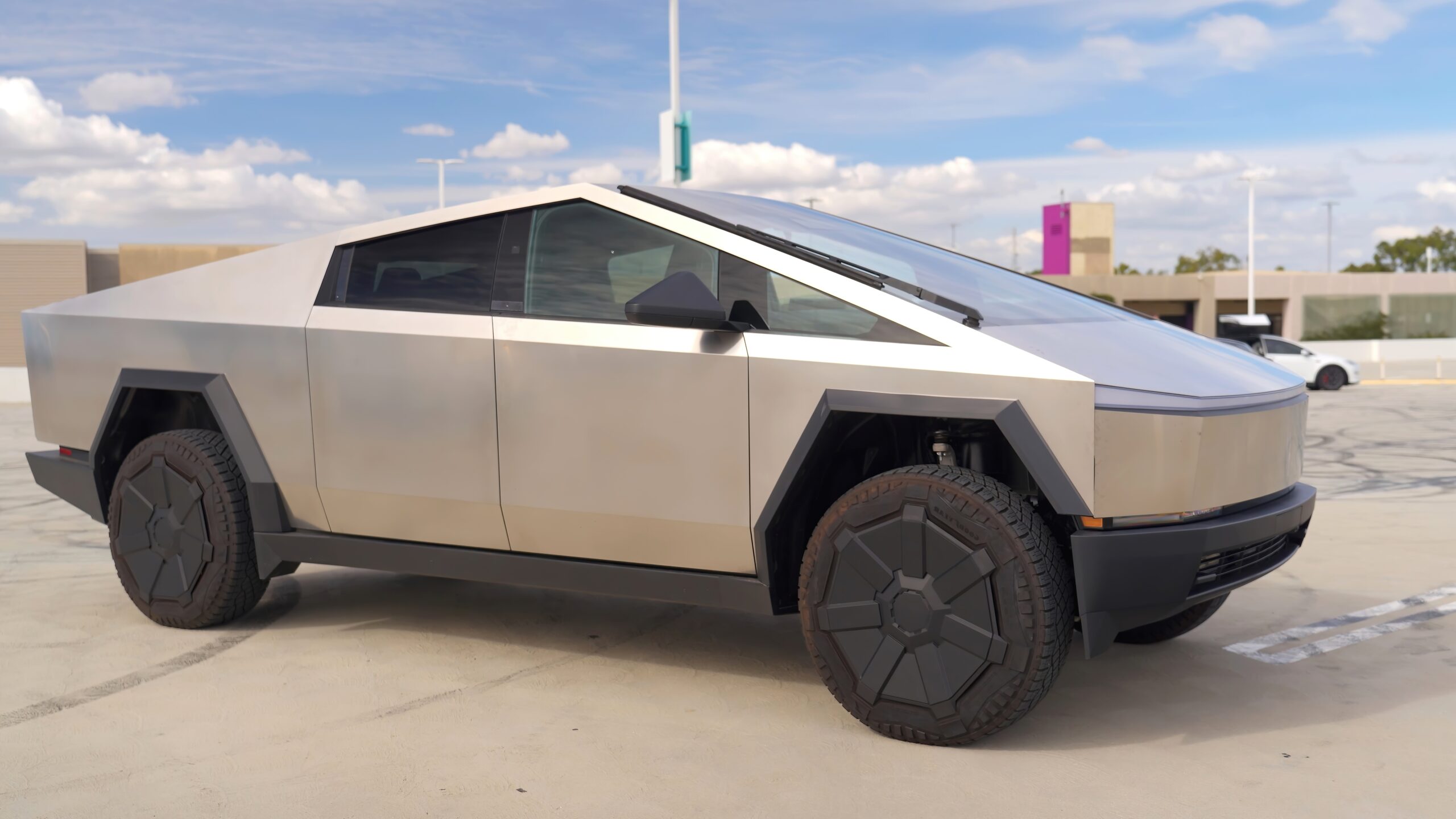
A Nashville-based Tesla Cybertruck owner decided to use his 2024 Cybertruck AWD Foundation Series as a full-time Lyft rideshare vehicle. He drove 100,000 miles in approximately 12 months.
Then Tesla sent him a $7,200 repair bill for a component failure that happened after his warranty expired, and he went on the Cybertruck Owners Club forum to share exactly what that experience felt like.
This is that story, and it contains a lesson that applies to anyone thinking about what EV ownership actually costs when you push the vehicle hard.
Nashville Driver Put 100k Miles On His Car in A Year
Most drivers put somewhere between 12,000 and 15,000 miles on a vehicle in a year.
The owner of this particular Cybertruck put more than six times that amount on his in roughly the same period. The math on how that happens is straightforward once you understand the setup.
He took delivery of one of the first 10,000 Cybertrucks built, the Foundation Series trim that Tesla produced for its earliest reservation holders, in early 2024 and immediately put it to work. Not as a weekend vehicle.
Not as a truck for occasional hauling. As a full-time Lyft rideshare vehicle in Nashville, running long shifts day after day.
A typical Lyft shift for this owner lasted around 7.5 hours. Do that consistently enough, in a city with active rideshare demand, and 100,000 miles in 12 months becomes entirely possible.
It requires discipline, consistency, and a willingness to treat what is effectively a luxury truck as a commercial work vehicle, but it is achievable.
The Cybertruck turned out to be a surprisingly effective rideshare vehicle in one specific way. Passengers loved it.
The owner reported consistent compliments about the spacious cabin, the massive panoramic roof, and the smooth ride quality.
In a rideshare market saturated with Toyota Priuses and Nissan Altimas, a Cybertruck is a genuine novelty.
Passengers are climbing into something they have never ridden in before, and that novelty translates into positive feedback and, presumably, better ratings for the driver.
Whether novelty is worth a six-figure sticker price as a commercial vehicle is a separate question.
The rideshare experience itself, for both driver and passenger, apparently worked.
Tires Make A Huge Part Of The Repairs
The first major expense was the one nobody should find surprising. After 100,000 miles, the original tires were done.
The owner replaced them with a set of Michelin Defender Platinum LTX tires at a cost of approximately $2,500.
That is not a small number, but it is also not an outrageous one given the context. The Cybertruck AWD weighs approximately 6,843 pounds, nearly 7,000 pounds of steel, battery, and stainless steel exoskeleton bearing down on four contact patches of rubber.
Heavy vehicles eat tires faster than lighter ones. Heavy EVs eat tires faster still because of the additional torque they deliver at launch and the regenerative braking forces they apply during deceleration.
A 7,000-pound truck running Lyft shifts in Nashville is going to go through rubber at a pace that a sedan driver would find alarming.
The $2,500 tire bill is the expected cost of operating a vehicle this heavy at this mileage. The owner acknowledged as much. It was not what frustrated him.
The $7,200 Problem
What frustrated him was the Power Conversion System.
At some point after the truck crossed beyond its basic warranty coverage, the Power Conversion System, a critical component that manages how electrical power flows between the battery pack, the motors, and the charging infrastructure, needed to be replaced.
Tesla swapped out the existing Rev E unit for a newer Rev F version. The bill was $7,200.
To put that in perspective: $7,200 is more than many people pay for a used car outright.
It is the kind of repair bill that makes you stop and do math on whether you are still coming out ahead. It landed entirely on the owner because the truck had already moved past its warranty window.
The owner did not mince words on the Cybertruck Owners Club forum. “Tesla shows no mercy when you’re outside your warranty, literally, none,” he wrote.
That quote is worth sitting with. Tesla’s warranty structure on the Cybertruck covers the basic vehicle for 4 years or 50,000 miles, whichever comes first.
The battery and drive unit warranty extends to 8 years or 150,000 miles. The Power Conversion System’s warranty classification depends on how Tesla categorizes it, and at 100,000 miles in one year, the basic vehicle warranty was certainly expired.
The owner was on his own for a $7,200 bill on a component that most buyers do not think about when they are sitting in a showroom.
This is not a Cybertruck-specific problem.
It is an EV-specific problem that the Cybertruck illustrates particularly clearly because of how the vehicle was used.
When you drive any EV hard enough, you are eventually going to encounter repair costs for components that have no equivalent in a gasoline vehicle, components that many mechanics outside the Tesla service network cannot touch and that the manufacturer prices accordingly.
What The EV Math Actually Looks Like
The standard pitch for EV ownership centers on fuel savings. Electric power costs less per mile than gasoline in most markets, and when you are driving 100,000 miles in a year those savings add up to a real number.
A Lyft driver burning through that kind of mileage in a gas-powered vehicle would spend a significant amount on fuel that the Cybertruck owner avoided.
But fuel is not the only operating cost. There are tires, $2,500 in this case, a number that will recur every 100,000 miles or so if the vehicle keeps operating at this pace.
There is the Power Conversion System at $7,200. There are the approximately 46 recalls the Cybertruck accumulated in its first year of production, a figure that represents one of the highest recall rates for any new vehicle in recent memory, though most of those were addressed under warranty.
There is the general reality that when something goes wrong with a component that only Tesla can diagnose, repair, and supply parts for, you are not shopping around for a better price. You are paying what Tesla charges.
The owner’s conclusion was not that the Cybertruck is a bad vehicle. He said it performed well as a rideshare car, clearly impressed his passengers, and handled the commercial use case better than many would have expected.
His conclusion was more specific than that. Driving 100,000 miles in a year in any vehicle is going to generate costs, and the assumption that EV fuel savings cover all of those costs is an assumption that does not survive contact with a $7,200 repair bill.
The Broader Lesson
There is a version of EV ownership that works out the way the marketing suggests.
You charge at home, you avoid gas stations, you reduce your maintenance costs by eliminating oil changes and reducing brake wear through regenerative braking, and over 150,000 miles or so you come out meaningfully ahead compared to a comparable gasoline vehicle. That math is real.
There is also a version of EV ownership that looks like this Nashville driver’s experience.
You use the vehicle as a commercial asset, you push it to mileage levels that expire the basic warranty in under a year, and when something goes wrong with a specialized component that costs $7,200 to replace, you absorb that cost in full because there is no warranty left and no alternative service network that can help you.
Neither version of the story is the complete picture. Both are true simultaneously.
The Tesla Cybertruck drove 100,000 miles as a Lyft vehicle in Nashville. Passengers loved riding in it. The tires wore out, which was expected.
The Power Conversion System failed, which was expensive. The owner paid $7,200 and went on a forum to tell other Cybertruck owners what that felt like.
“Tesla shows no mercy when you’re outside your warranty, literally, none.”
That sentence is not an indictment of Tesla or of the Cybertruck specifically.
It is a description of how the math works when you push any vehicle to its limits and then step outside the safety net that the warranty provides.
It just happens to cost $7,200 in this particular case, and the truck that generated that bill is one of the most unusual, polarizing, and talked-about vehicles on American roads right now.