Earthquake Study Finds Japan's 2011 Quake Made The Entire Country Move And Nobody Felt It
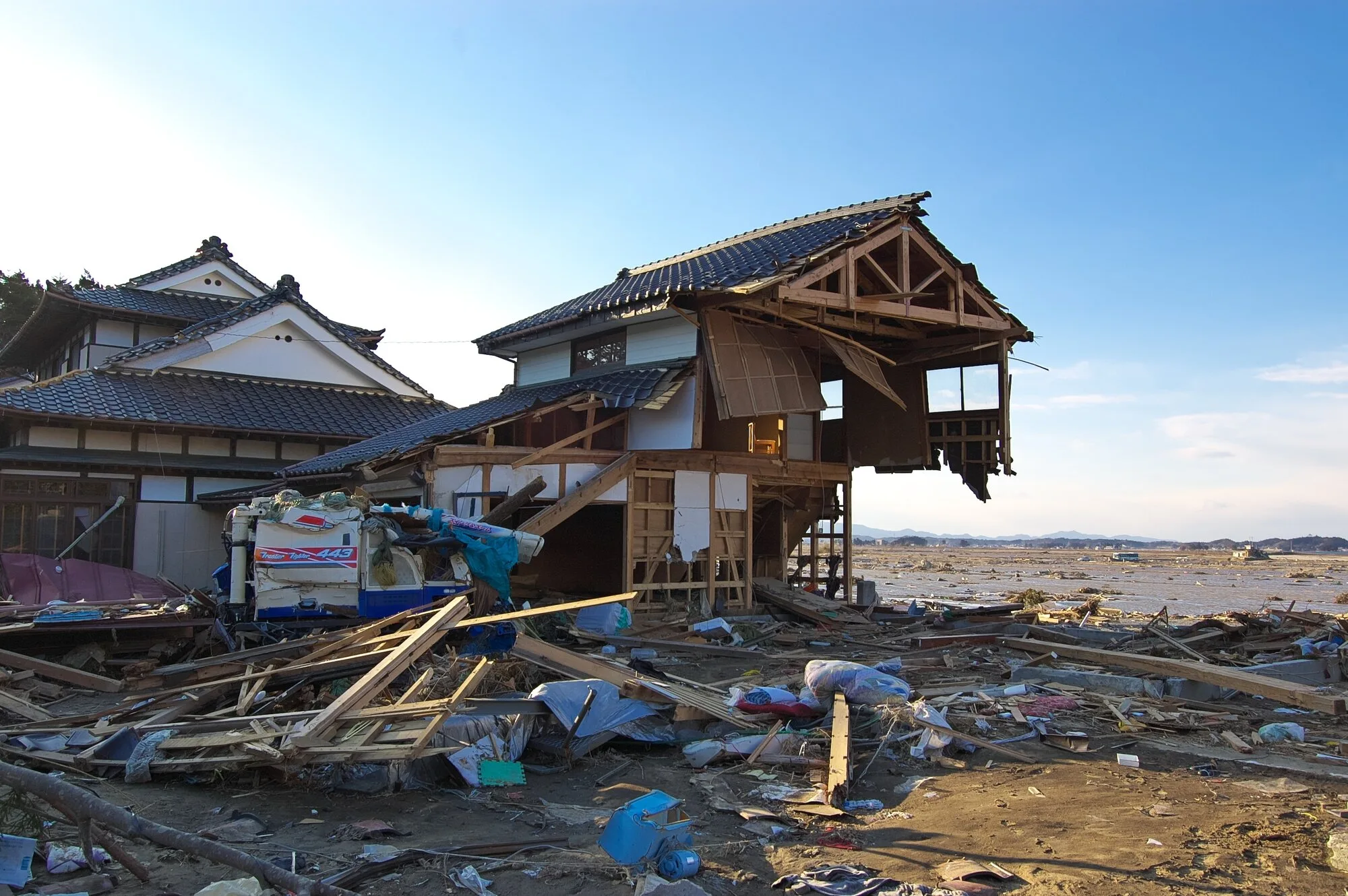
A new study published Thursday in the journal Science confirms something that sounds like it belongs in a disaster movie but happened in reality, and silently, which is somehow more unsettling. Japan's catastrophic 2011 Tohoku-Oki earthquake, the magnitude 9.0 event that killed more than 18,000 people and triggered the Fukushima nuclear disaster, was so powerful that it caused the entire country of Japan to physically shift position.
In some areas, the movement was as much as five or six millimeters. Nobody felt it.
It happened approximately 15 minutes after the main shaking had stopped, when most people would have assumed the worst was over.
The researchers who documented the movement did not expect to find what they found. Sunyoung Park, an assistant professor of geophysics at the University of Chicago and the study's lead author, described the initial reaction in her own words:
"The co-authors and I, we were all kind of initially puzzled by the observation. Because this was such an unusual thing, we took a lot of time going through different possibilities."
They ruled out processing errors in the satellite data. They ruled out other explanations.
What they were left with was the correct one: seismic waves from the 2011 earthquake had traveled down through Earth's mantle, bounced off the planet's iron core and come back up to the surface, where they nudged the entirety of Japan in a direction it had not been pointing before.
The Mechanism Nobody Had Seen Before
The waves responsible for the movement are called ScS waves, S standing for shear, c standing for core, the second S indicating they are shear waves again on the way back up.
The path they travel is extraordinary in its own right, generated at the surface by the earthquake, they drill down through roughly 3,000 kilometers of rock and molten material to reach Earth's iron core, reflect off it like light off a mirror and travel the same distance back up.
The round trip took approximately 15 minutes from the moment the main earthquake struck.
When the ScS waves returned to the surface, they encountered a Japan that had already experienced the main shock and that was in the process of settling.
What they triggered instead was something researchers had never documented at this geographic scale, a "slip" affecting the entire country simultaneously, occurring gradually over approximately 100 to 200 seconds.
The slip was too slow and too subtle to be felt. People standing in Tokyo or Osaka or Sendai in the minutes after the most powerful earthquake in Japan's recorded history had no way of knowing that the ground they were standing on was quietly sliding several millimeters in a direction it had not previously occupied.
The area affected by this post-earthquake slip was six to seven times larger than the area that ruptured during the original magnitude 9.0 event.
The original rupture, catastrophic, civilization-altering, the cause of 18,000 deaths, was itself enormous.
The ScS-triggered slip covered a geographic footprint nearly seven times that size.
Why Five Millimeters Matters When It Covers An Entire Country
Five or six millimeters is not a number that conveys obvious danger in isolation. It is roughly the length of an adult's pinky toenail.
Land shifts by more than that constantly, in active seismic zones, in the vicinity of fault lines, near volcanoes.
The earthquakes that crack roads and offset fence posts and disconnect pipelines produce movements measured in feet, not millimeters.
The significance of the Japan slip is not its magnitude. It is its scope and its timing.
Localized land movement near the center of an earthquake is expected and well-studied. Movement affecting an entire country simultaneously, triggered not by the original rupture but by seismic waves that bounced off the planet's core fifteen minutes later, had never been documented before.
Earthquake geologist Wendy Bohon, who was not involved in the study but reviewed it, described the finding as "extraordinary" and confirmed that ScS waves as a trigger for this kind of widespread slip represents "a previously unrecognized source" of seismic hazard.
The phenomenon the researchers are describing falls within a broader category called dynamic earthquake triggering, the process by which seismic waves from one earthquake trigger slip or additional earthquakes on other faults.
This process is well established in the scientific literature. The specific mechanism, ScS waves bouncing off Earth's core and causing country-scale slip many minutes after the original event, is new.
The Hazard That Comes After The Shaking Stops
The practical implication of the Japan finding is the part that Park described most carefully and that has the most relevance for earthquake preparedness.
The slip that the ScS waves triggered happened after the main shaking was over.
By the time it occurred, people in Japan had survived the initial earthquake and were in the process of responding, evacuating, checking on family members, assessing damage.
The secondary movement was not felt. But the question the researchers are now asking is whether it has to be that way.
"I think we should be aware of the fact that there could be this potential triggering of an event many minutes after the main shaking has passed," Park said. "This 'new type of seismic hazard' is one which we might want to think about."
The 2011 case produced slip that was too subtle to cause additional damage, the movement was gradual and small relative to the devastation the original quake produced.
But more research is needed to determine why the Tohoku-Oki earthquake produced this effect and whether future earthquakes of comparable magnitude might produce ScS-triggered slip that is faster, larger or more damaging.
The key variable Park identifies is whether future events might produce slip that people would actually feel, and whether that slip, in the wrong geological circumstances, might trigger additional hazards.
The Earthquake That Changed Japan
The Tohoku-Oki earthquake struck on March 11, 2011 at 2:46 PM local time, with its epicenter approximately 70 kilometers off the coast of the Oshika Peninsula in northeastern Japan.
The magnitude 9.0 event was the most powerful earthquake ever recorded in Japan and the fourth most powerful in the world since modern seismographic measurement began.
The tsunami it generated reached heights of up to 40 meters in some coastal locations, inundated 560 square kilometers of coastal land and killed 18,000 people, with roughly 2,500 still listed as missing more than a decade later.
The economic damage was estimated at $220 billion in 2011 dollars. The Fukushima Daiichi Nuclear Power Plant, flooded by the tsunami, experienced three reactor meltdowns in the worst nuclear accident since Chernobyl.
An exclusion zone around the plant remained in place for years.
That earthquake, that specific, devastating, world-historical event, was also, it turns out, powerful enough to send seismic waves to the center of the Earth and back, and when those waves returned to the surface, they moved the country.
Fifteen minutes after the shaking stopped. Five or six millimeters. Nobody felt it.
The study is published in Science. Park and her team are continuing their research.